
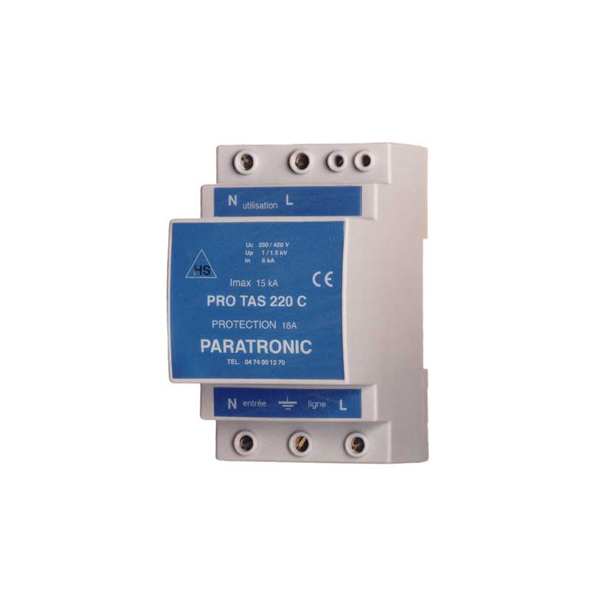
PARATRONIC’s technical sales engineers regularly observe the devastating impact that a direct lightning strike or an induced power surge can have on industrial water infrastructure (such as wastewater treatment plants, reservoirs, pumping stations, booster stations, etc.).
Given the increasing sensitivity of equipment, implementing a robust strategy to protect against lightning and power surges is no longer an option but an operational necessity to safeguard your facilities.
At PARATRONIC, we design state-of-the-art solutions to protect your low-voltage (LV) and extra-low-voltage (ELV) networks.
Lightning generates extremely high surge currents. Without proper protection, these currents seek the path of least resistance, traveling through your wiring and instantly destroying circuit boards, PLCs, and data acquisition systems.
– Direct effects: The physical impact on the structure, which is mitigated by a lightning rod.
– Indirect effects: Transient surges traveling through power or signal cables—often caused by lightning strikes—can be mitigated by installing PARATRONIC surge protectors.
Depending on:
– the type of power supply (30 V, 220 V, 400 V, etc.),
– the number of conductors to be protected.
– the surge current capacity related to the site’s exposure to lightning (kerauanic level, denoted as “Nk” for your location).
– Residual voltage also affects the effectiveness of the protection provided by the immunity of the equipment being protected.
Our low-voltage surge arresters are designed to divert destructive energy to ground before it reaches your electrical panels. They are classified according to the NF EN 61643-11 standard to accommodate every configuration based on the type of surge arrester (see table).
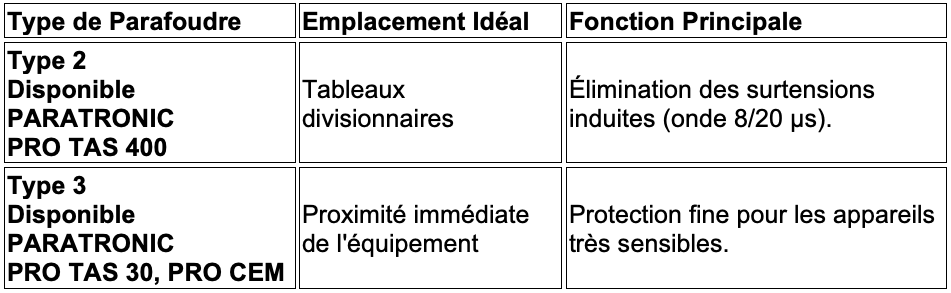
Classification of low-voltage surge arresters according to standard NF EN 61643-11
PARATRONIC’s tip: The effectiveness of a low-voltage surge arrester depends on the quality of its grounding. The 50-cm rule, combined with a larger cable cross-section (maximum length of the connection conductors), is essential for minimizing inductance and, consequently, residual voltage.
Connectivity is at the heart of the water industry. Measurement lines (4–20 mA sensors, SDI12, etc.), communication buses (RS-485, Ethernet), and remote management systems are particularly vulnerable to power surges, even minor ones.
PARATRONIC excels in protecting low-level signals with devices that feature ultra-fast response times:
– Measurement loop protection: Our modules protect your level, pressure, or flow sensors without compromising signal accuracy.
– Protection of data acquisition systems: Our solutions protect your PLCs connected to your data acquisition systems.
– Compact design: Easy to mount on a DIN rail in your electrical enclosures.
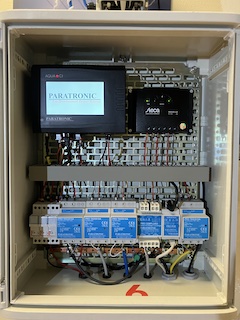
AQUA-CJ set
When you choose PARATRONIC, you’re choosing proven French expertise.
Our products don't just meet standards; they are tested under real-world conditions to ensure three key factors.
Drastic reduction in production downtime.
Clear status indicators on surge arresters to visually identify whether a module needs to be replaced. The PARATRONIC GR800 from PARATRONIC allows you to assess the condition of the surge arrester during your maintenance rounds.
From on-site audits to selecting the right product, our technical sales engineers will support you in your safety efforts.
To ensure effective protection of your facilities against lightning, it is essential to maintain a strict physical separation between the various networks.
Never route low-voltage (LV) power cables—which are inherently “noisy” during discharge—alongside signal and measurement cables (HV), which are extremely sensitive to inductive coupling.
Immediate proximity within the same conduit can cause spark-over or radiated overvoltage, rendering your surge arresters ineffective.
Strictly follow the 50-cm rule for grounding, and use separate cable trays or shielding to isolate high-voltage currents from data loops.
This compartmentalization is key to preventing lightning energy from "jumping" from one conductor to another and destroying your PLCs or communication cards.
It is common to see separate grounding systems (such as "electrical" grounding, "lightning" grounding, and "IT" grounding) set up by mistake. This poses a major risk: in the event of a lightning strike, a potential difference of several thousand volts can arise between these grounding points, causing destructive electrical arcs to jump across your equipment.
All grounding points at a given site must be interconnected to form a single potential reference.
The use of PARATRONIC surge arresters, combined with a robust grounding system, ensures that your entire station (from the high-voltage distribution panel to the low-voltage sensors) “rises” to the same potential simultaneously, thereby eliminating any risk of destructive stray current flowing between ground points.
By following these best practices for implementation, you maximize the effectiveness of PARATRONIC solutions and ensure seamless protection for the most critical infrastructure in the water cycle.
Would you like to have your system inspected or receive a specific wiring diagram? Please contact us using the contact form.
News
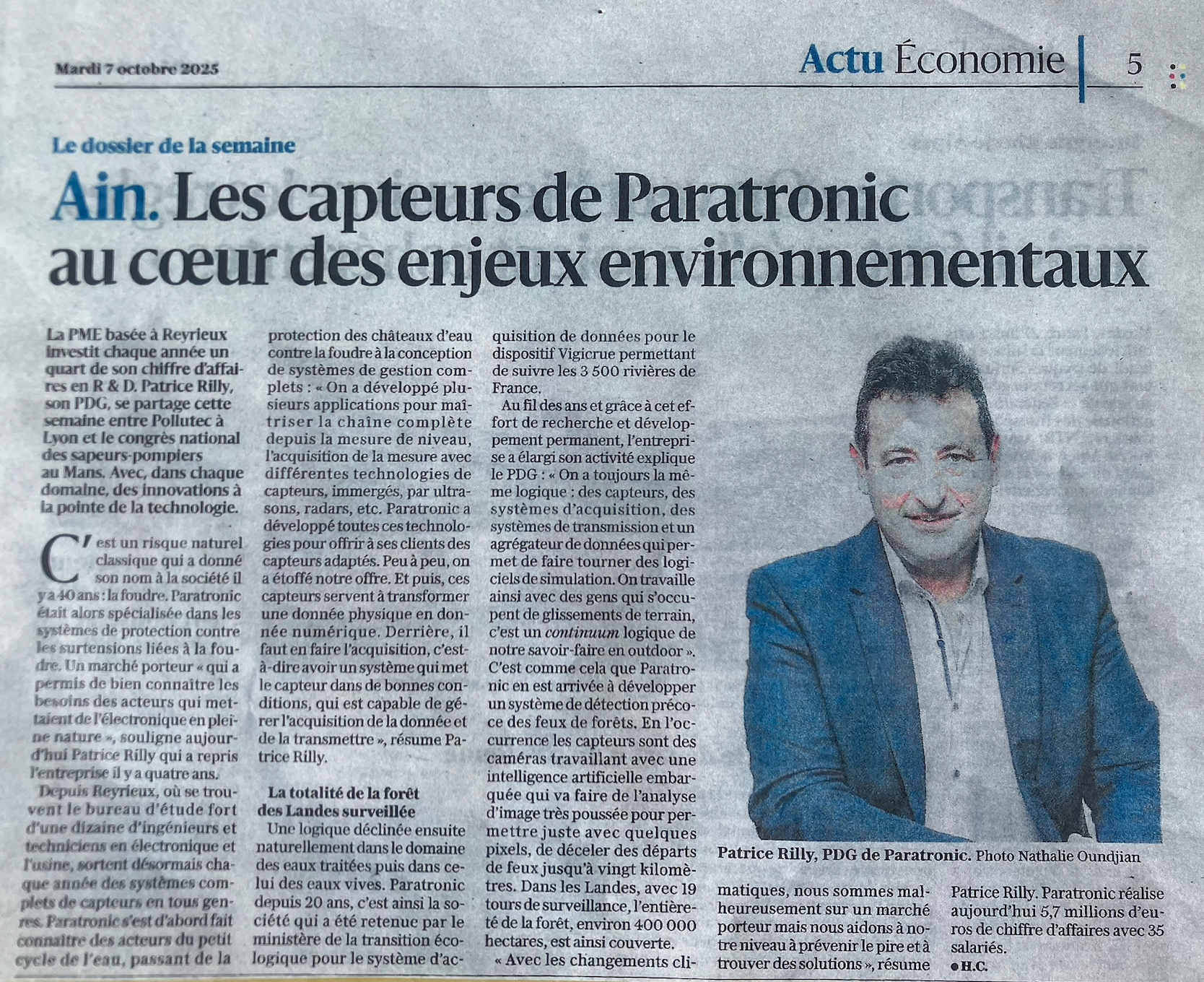
PARATRONIC, an SME based in the Ain region specializing in high-tech sensors, is establishing itself as a key player in the ecological transition, from Vigicrue river monitoring to forest fire detection. From lightning protection to artificial intelligence for fire prevention: focus on the Reyrieux-based company that monitors 3,500 rivers and 400,000 hectares of forest in France.
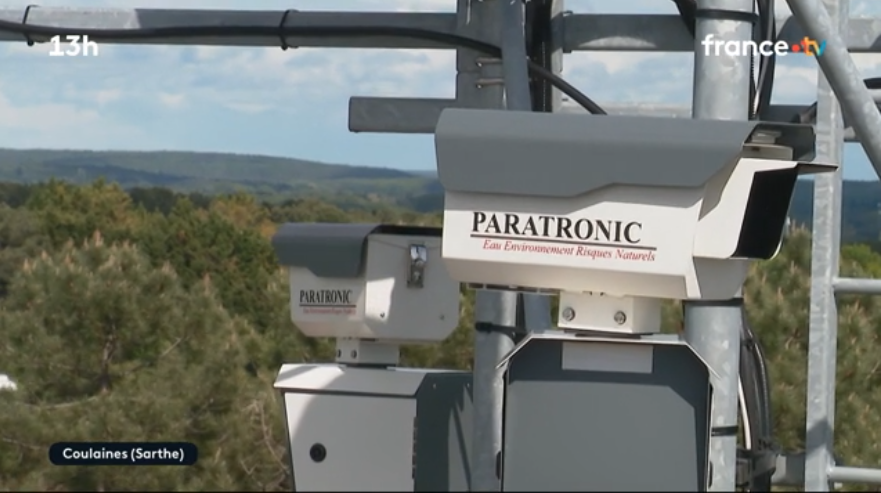
Large engineering firms need to rely on specialized sensor suppliers such as PARATRONIC, one of the leading players in the market, with sensors designed to detect high water, flooding, low water, dry water tables and forest fires. Patrice Rilly CEO PARATRONIC talks to Smart City mag.

Paratronic
Industrial Zone Rue des Genêts
01600 REYRIEUX
T : +33(0) 4 74 00 12 70
F : +33(0) 4 74 00 02 42
Follow us on social networks


Contact us
Would you like to know more about our products or services? Call us directly at
+33(0) 4 74 00 12 70 or write to us.