
The quality of the installation and the choice of surge protectors starts from a good knowledge of the physical phenomena, the only ambition of this awareness is to approach in a concrete way the various practical aspects of lightning protection, installations and equipment common in the industry.
It is therefore aimed more particularly at technicians and engineers who are directly responsible for safeguarding the integrity of the means of production and ensuring continuity of service.
Of course, the protection of individuals remains the primary concern of any industry leader.
However, this field is a matter for specialists, and the electrical installation inspection bodies fulfil this role competently.
In the training, we therefore confine ourselves to the material aspect of the subject (lightning protection and surge arresters), even if a look at the personal protection aspect is sometimes sketched out.
A good approach to the subject, lightning protection, must be conducted with the constant will to demystify.
The importance of the damage, reflects as much the power of the phenomenon "lightning" as the little attention paid to the methods of protection.
Nothing can be done against lightning''.
This is an extremely common and yet particularly false idea.
A resolutely technical approach can only convince of the contrary
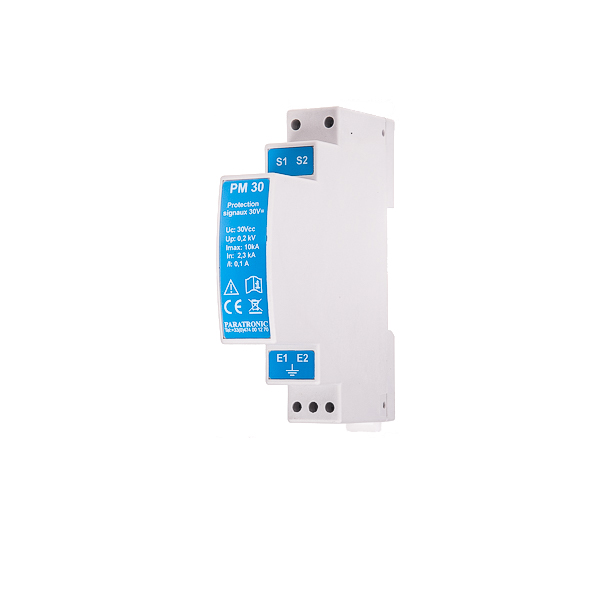
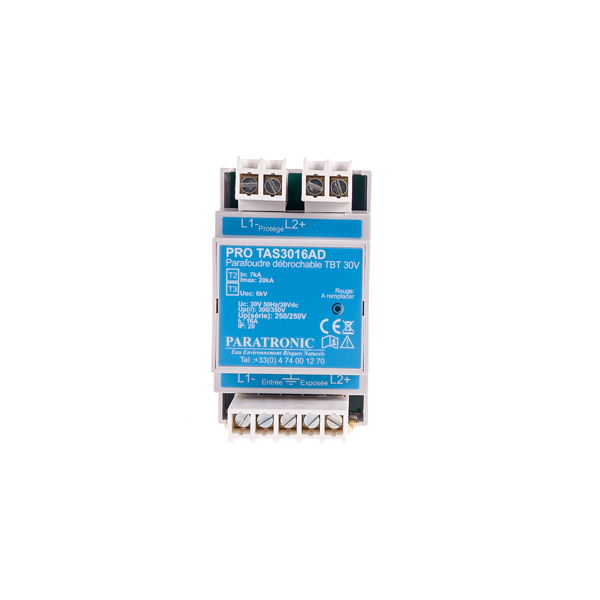
Use surge arresters with high flow capacity (15/20 KA) and low residual voltage (series wiring), of voltage suitable for use as PRO TAS surge arresters or, failing that, as PM surge arresters, protect all lines arriving or leaving the site.
Make equipotential connections between the different grounds (neutral ground, earth ground, ....) and the pipes (use cables with a minimum of 16 mm2 ) and carry out these connections as directly as possible.
Whenever possible, place the surge arresters outside the cabinets, in a separate surge arrester box, as close as possible to the ground input. Otherwise, mount the surge arresters at the bottom of the cabinet, as close as possible to the earth bar (connect it with a 25 mm2 cable, as straight as possible, to the earth.
Make the "surge protector" / earth connections as short and straight as possible with conductors of at least 4 mm2 for the power supply and at least 2.5 mm2 for the transmission lines.
- Wherever possible, avoid running cables protected by surge arresters with unprotected cables or, even more so, with circuits for the flow of shocks to earth (induction). Avoid the proximity of low currents to high currents.
- Use shielded cables for overvoltage arrester protected circuits (shield grounded on one side only).
- In order to obtain the durability of the protection provided by surge protectors it is necessary to:
- Regularly check and maintain the quality of the land interconnections.
- Check regularly (twice a year), using appropriate equipment (surge arrester tester). GR800 surge arresters) the state of the overvoltage arresters (static ignition voltage). Replace surge arresters if necessary.
Surge protectors PRO TAS400 – PRO TAS400C are connected in parallel with an associated protection (16A curve C circuit-breaker or 50A gL 14×51 fuses), either downstream of the LV main circuit-breaker or on the 400V inlet of the electrical cabinet.
Possibility of wiring the auxiliary contact (version C), overvoltage arresters, with opening on fault following disconnection of the lightning protection (or lightning arrester) in the event of a possible thermal runaway of the lightning protection or lightning arrester, to an alarm input of the remote management.
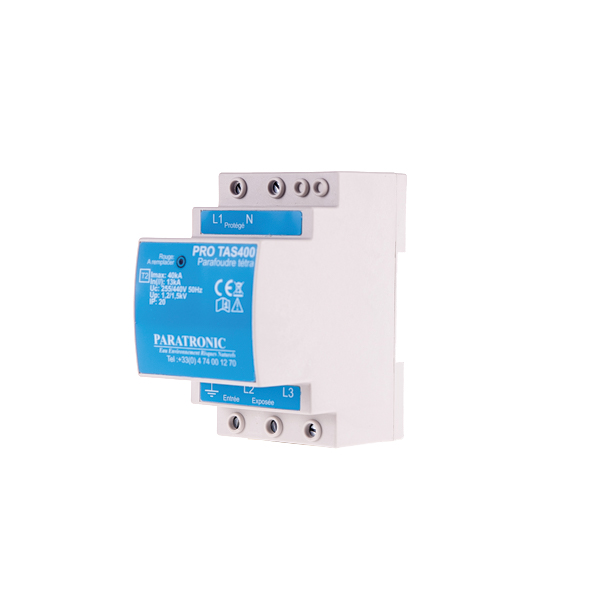
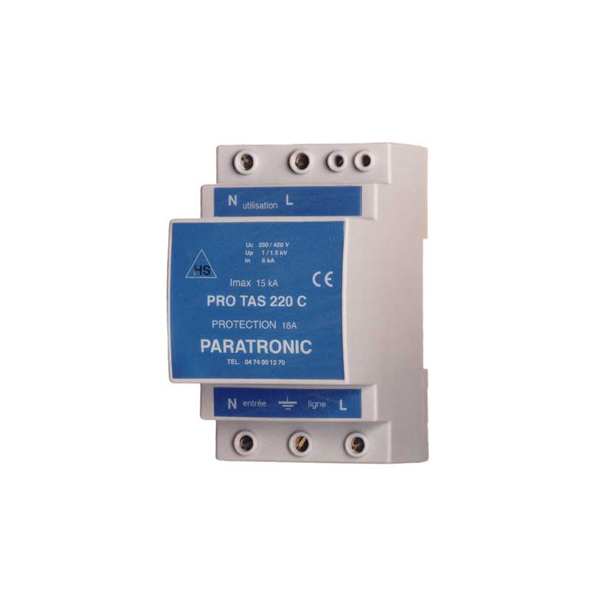
.
Surge protectors PRO TAS220 – PRO TAS220C – PSD40 – PSD40C can be connected in series up to 16A operating current. Beyond this, the overvoltage arresters will be connected in parallel with an associated protection (16A curve C circuit breaker or gL 14×51 fuses of 25A).
Possibility of wiring the auxiliary contact (version C) of the lightning protection and overvoltage arresters, with opening on fault following disconnection of the lightning protection in the event of a possible thermal runaway of the overvoltage arresters, to an alarm input of the remote management.
Equipment connected to a network is subject (e.g. during storms) to power surges.
In such cases, the equipment is damaged when the potential difference appearing at its terminals is greater than its insulation.
Two protection strategies are then possible:
* an insulation strategy,
* a flow strategy
For telephone lines, galvanic separation is used, using specific products.
(such as Mimosa, Isotel or other transducers that are not surge suppressors).
This type of solution amounts to increasing the level of isolation of the equipment you wish to protect.
There are two disadvantages to this technique:
* the generally high cost.
* The uncertainty that the insulation obtained will be sufficient with regard to the tensions which will appear during the next shock.
This is the strategy on which the PRO TAS120surge protectors are based.
Surge suppressors PRO TAS120 are devices that prevent voltage surges at the terminals of a device connected to a PSTN telephone line.
surge suppressors PRO TAS120 detect a possible overvoltage, generally of atmospheric origin, appearing on the protected line. They then flow the surge current to earth, thus preventing the voltage from rising.
There is a drawback to this technique:
* the determination of an overvoltage level that both protects the equipment and does not disturb the line during normal operation.
Surge protectors PRO TAS120 have been studied so that the operation of the line is not disturbed by surge protectors. Indeed, when this surge protector was developed, its marketing was subject to the approval of France Telecom (the surge protector PRO TAS120 has obtained approval number 94271X). Today these surge protectors no longer need such approval, but are subject to self-certification regulated at European level. Without the need for any modification, the overvoltage arresters PRO TAS120 also meets these requirements defined by the European Telecommunications Standards Institute (ETSI).
Approximately 10,000 lines are currently successfully protected in France by surge protectors PRO TAS120.
The variety of equipment protected bysurge protect ors is very diverse. PRO TAS120 so much to prove, if need be, the quality of this surge protector.
Finally, the economic criterion is also to be taken into account in the choice of a lightning protection technique. It is always difficult to estimate the lifetime of a surge arrester. It depends on the energy and frequency of the shocks to be discharged by the surge arresters. It is commonly accepted that the average shock on a line is 5000A. Surge protectors PRO TAS120 are capable of dealing with a hundred such shocks.
An interconnection of the LV earths with the transformer station earths (HV and neutral earths) must be ensured.
In order to ensure interconnection of the LV land with the downspout of the EDF pole (if the latter is less than 30 metres from the installations), an interconnection spark gap must be inserted. TS100 (isolation 1000 Mohms).
In the presence of an overhead France Télécom line, it is necessary to check the existence of a pole-mounted earthing system less than 30 metres from the installations. If this is the case, this earth should be interconnected to the LV land of the installations.
Ensure equipotential bonding on all pipes and metal parts, in particular borehole casing, borehole discharge pipe, frame and pipes of recovery pumps, etc...

Replace diode bridge rectifiers with power supplies that are marked CE.
Prefer immersed level probes PARATRONIC CNR or MPXF (depending on the measuring range).
These sensors have a lightning strike resistance of 20 KA without additional surge arresters and are equipped with a galvanic separator.

Paratronic
Industrial Zone Rue des Genêts
01600 REYRIEUX
T : +33(0) 4 74 00 12 70
F : +33(0) 4 74 00 02 42
Follow us on social networks


Contact us
Would you like to know more about our products or services? Call us directly at
+33(0) 4 74 00 12 70 or write to us.